

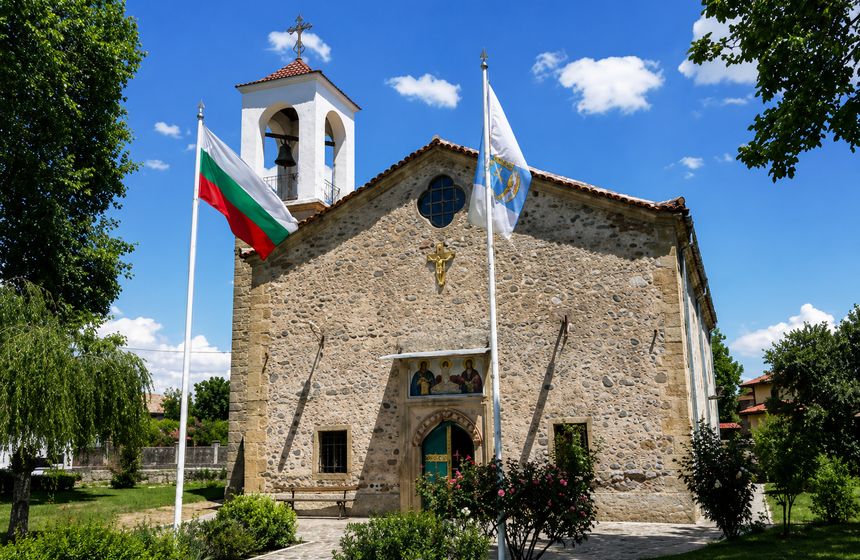
St. Constantine and Helena Church
It was built in 1860 and consecrated by Father Dimo, the first priest in the church. During the Russo-Turkish Liberation War of 1877–1878 it was burned down and restored after the Liberation.
According to its plan, the church is a three-nave pseudo-basilica, a type of building widely spread during the Bulgarian Revival. The bell tower rises above the church building, but is structurally united with it and does not disturb the overall silhouette of the building. The church has one apse, five-sided on the outside.
Next to it is the grave of the longest-serving priest in the church, Father Petko Minchev, who served from 1944 to 2001. On the western façade, above the central entrance, the images of St. Constantine and Helena are painted on the outside.
Inside, the church has 8 stone columns, arranged 4 opposite 4, supporting the arches above them and the vaults. The church was painted in 1985–1986 by the artists Asen Gitsov from Sofia and the Plovdiv artist Mihail Minkov.
On the western wall above the entrance, inside, there is an inscription with the names of the chairmen of the church board under which the church was painted, the names of the artists, and the year of painting.
Until 1990, the church also kept a gilded table cross donated by Exarch Stefan, which unfortunately is no longer there, together with 25 original icons painted before the Liberation, 10 silver kandilas, a chalice, a copper ewer, and the tabernacle.
In 1943, a free school canteen for poor pupils was opened, supported by the Bagarov family, and it operated until the end of the school year. A member of the audit commission of the consumer cooperative, and from 1950 permanent chairman of the beekeepers' society. He himself was a beekeeper, gardener, vine-grower… a servant of God. Due to a lack of priests, he also served in the villages of Pesnopoy, Mihiltsi, and Ivan Vazovo, while managing to repair the church.