

Thracian cult centre – Starosel
Only 20 km from the town of Hisar is the village of Starosel, which became the sensation of the year 2000. It is located on a hill from which the whole Thracian valley can be seen. The Thracians chose such places for temples. The archaeological expedition of Dr. Georgi Kitov discovered for the world “the largest preserved Thracian royal complex with a temple-mausoleum in Southeastern Europe”. The assumptions are that the temple is from the time of the Thracian king Sitalk, or even of the ruler himself.
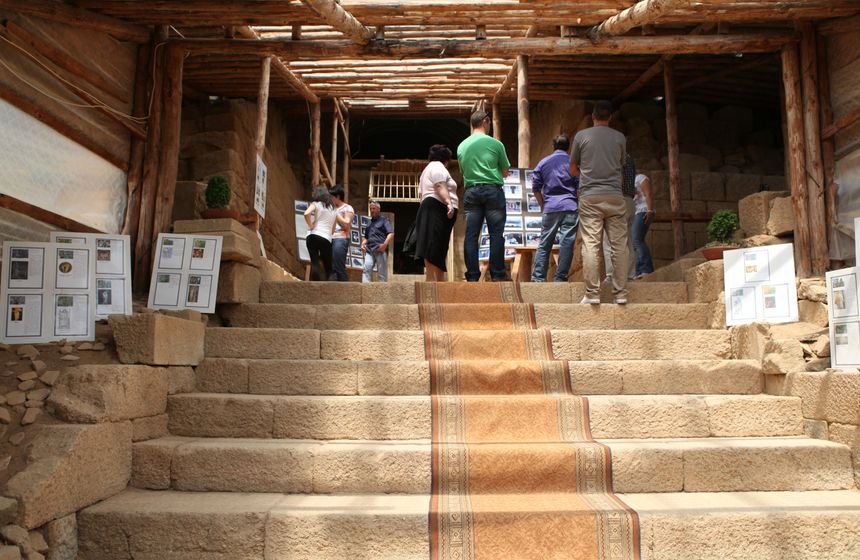
In fact, for people who do not understand, like me, the temple is nothing special, but scientists say that it is the largest discovered so far, which is why so much was said about it. And the local people told me: “How many times have we eaten and drunk on this hill without knowing that beneath us there is such a treasure.” A ceremonial staircase with a monumental corridor, a cult platform and two chambers leads to the temple itself. In this room the initiate entered to connect with the gods. This architectural complex is the key to Thracian culture.
The Thracians did not have writing, but the preserved architectural and artistic monuments speak of a highly developed civilisation of precise architects. They soldered elements of jewellery 2300–2400 years ago! And this technique was patented only at the beginning of the last century... The royal burial found 30 m from the temple is exceptionally rich. From the sarcophagus were taken a massive gold signet ring with the image of a horseman, armour, arrows, silver, bronze and painted ceramic vessels, which are excellently preserved.
The masonry grave next to the temple, in which no skeleton was found, speaks of a “cenotaph” — a symbolic burial. Around a rock next to this grave a dismembered skeleton was found — either it was a sacrifice /as practised by the Thracians/, or a ritual burial.
Interesting - Next to the main temple a well-preserved stone tub — “winery” with a capacity of about 5 tons — was discovered, which suggests that “wine sacrifices” in honour of the god Dionysus were practised here.
-working hours: - summer season - 9:00 – 18:00, no day off - winter season – 8:00 – 17:00, no day off -ticket price: adults – 3.00 BGN; students – 1.00 BGN; -services - guide, postcards, brochures, souvenirs;
Besides the cult temple in the village of Starosel, in the area of the village during the period 2000–2002 four Thracian tombs from the 4th century BC were discovered, and with the two newly discovered in 2003 their total number became 6. It is characteristic that each of the six tombs is different from the others. The main temple is a key point of a large cult centre of many rock sanctuaries and several dozen mounds. In two of them smaller temples were found, also used as tombs-mausoleums. In others, high representatives of the Thracian aristocracy, chiefs or rulers were buried.
The one in Peychova Mound was a follower of Orpheus. In the 5th century BC his body was dismembered into three parts and buried around an obviously sacred rock. To the side of it a chamber with a pitched roof was built, to resemble a temple. In it were arranged the chief's belongings — a full set of weapons /greaves, armour, gilded breast-collar, gilded helmet, shield, sword, spearheads, bow with leather quiver, arrows whose wooden shafts are preserved/, two complete sets of silver ornaments for horse harness. Among the many other finds stands out the silver double axe /labrys/ — a symbol of royal power in ancient Thrace. The results of the studies so far give grounds to claim that the naturally gifted area around Starosel was an important cult centre of the Thracian Odrysi tribe during the Late Iron Age.